
Scotland’s Expanding Energy Infrastructure and Its Carbon Impact
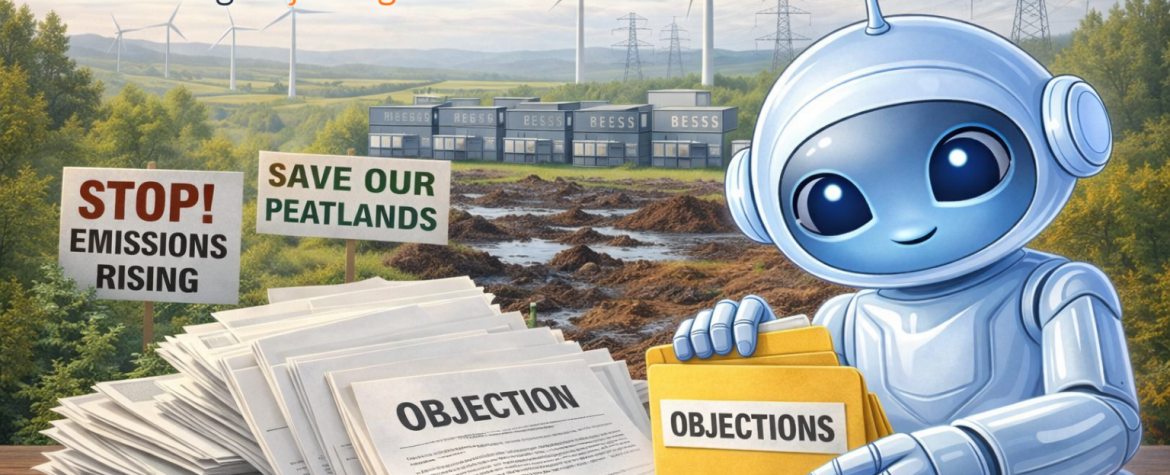
Scotland’s Energy Build-Out: Why Expanding Generation, Grid and Storage May Be Driving Emissions Up, Not Down
Scotland is undergoing a transformation unprecedented in its modern history. Onshore wind farms, offshore wind arrays, solar parks, battery storage compounds, substations, converter stations and long-distance transmission corridors are being developed simultaneously across land and sea. Together, these projects are presented as a decisive response to climate change. Yet when examined as a complete system rather than as isolated technologies, the evidence suggests a more troubling conclusion. The cumulative effect of Scotland’s current energy strategy risks increasing real-world carbon emissions while degrading the very environmental assets that have historically kept Scotland’s emissions comparatively low.
This is not a question of political preference or opposition to renewable energy. It is a matter of carbon accounting, infrastructure lifecycles, land use science and legal coherence.
Scotland’s emissions profile and the role of land
Scotland’s relatively low territorial emissions are often attributed to renewable deployment. In practice, they are deeply rooted in land use. Large parts of the country remain lightly industrialised and are dominated by peatlands, rough grazing, wetlands and semi-natural uplands. These landscapes store vast quantities of carbon accumulated over thousands of years.
From a legal and scientific standpoint, this matters because carbon stored in soils and peat is part of the national emissions balance. Once released through drainage, excavation or compaction, it cannot simply be offset by generating electricity elsewhere. Carbon lost from land is an immediate and often irreversible addition to atmospheric emissions within policy timescales.
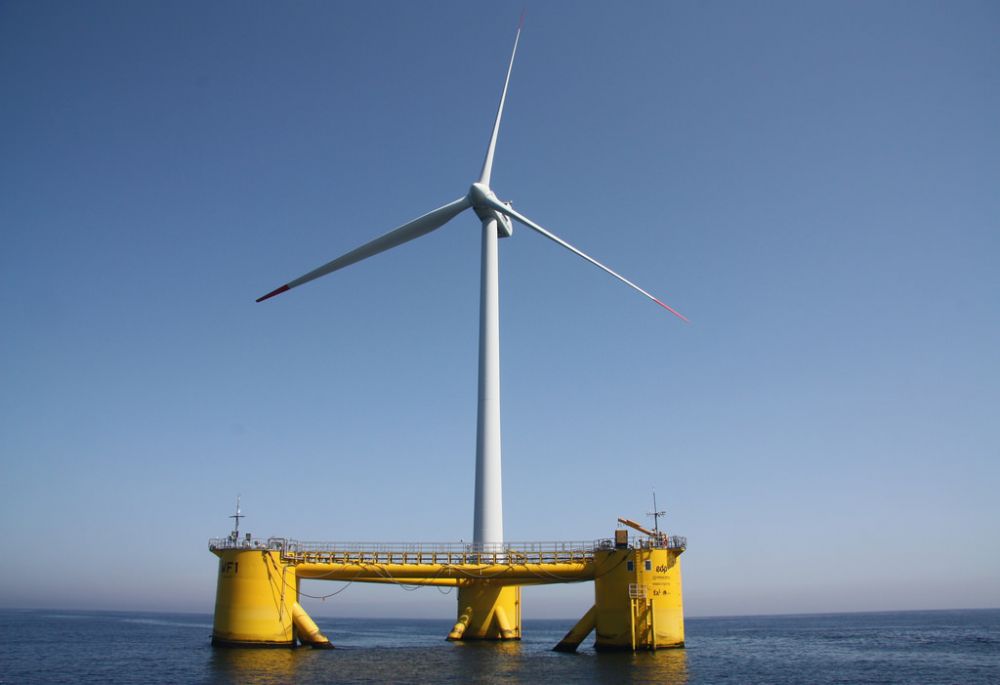
Energy generation does not exist in isolation
Public debate frequently treats wind, solar or storage as discrete solutions. In reality, energy generation is inseparable from enabling infrastructure. Every new source of electricity requires grid reinforcement, access, maintenance facilities and system balancing. Scotland’s current approach expands all of these elements at once.
Onshore wind developments require foundations, access roads, crane pads and substations. Offshore wind requires extensive port works, cable landfalls, onshore converter stations and new transmission capacity. Solar parks, often located on agricultural land, involve soil stripping, fencing, drainage modification and inverter compounds. Battery storage introduces further industrial sites whose sole purpose is to manage surplus electricity.
Each element has an emissions footprint that is rarely assessed cumulatively.
Construction emissions and material intensity
Modern energy infrastructure is material heavy. Steel, concrete, aluminium, copper and rare earth elements are central to turbines, pylons, substations and batteries. Their production is energy intensive and largely dependent on fossil fuels. These emissions occur before a single unit of electricity is generated.
From a legal perspective, lifecycle assessment is meant to capture this reality. In practice, many assessments rely on optimistic assumptions about operational lifespan and system efficiency while downplaying upfront carbon costs. When projects are approved sequentially rather than strategically, those costs compound.
The issue is not that construction emits carbon. It is that Scotland is now engaged in near-continuous construction across large areas of the country, transforming emissions from a one-off cost into a persistent feature of the energy system.
The short lifespan problem
A critical but under-examined factor is infrastructure lifespan. Wind turbines are typically designed for operational lives of around twenty to twenty-five years. Solar panels degrade over time and require replacement. Battery storage systems have even shorter functional lifespans, often a decade or less at grid scale. Grid infrastructure itself is subject to continual upgrading as capacity increases.
This creates a cycle rather than a solution. Infrastructure is built, operates, degrades, and is rebuilt. Each cycle brings new material extraction, new construction emissions and further land disturbance. On carbon-rich land, particularly peat, these repeated interventions compound carbon loss.
From a systems perspective, Net Zero assumes permanence. Scotland’s energy build-out is anything but permanent.
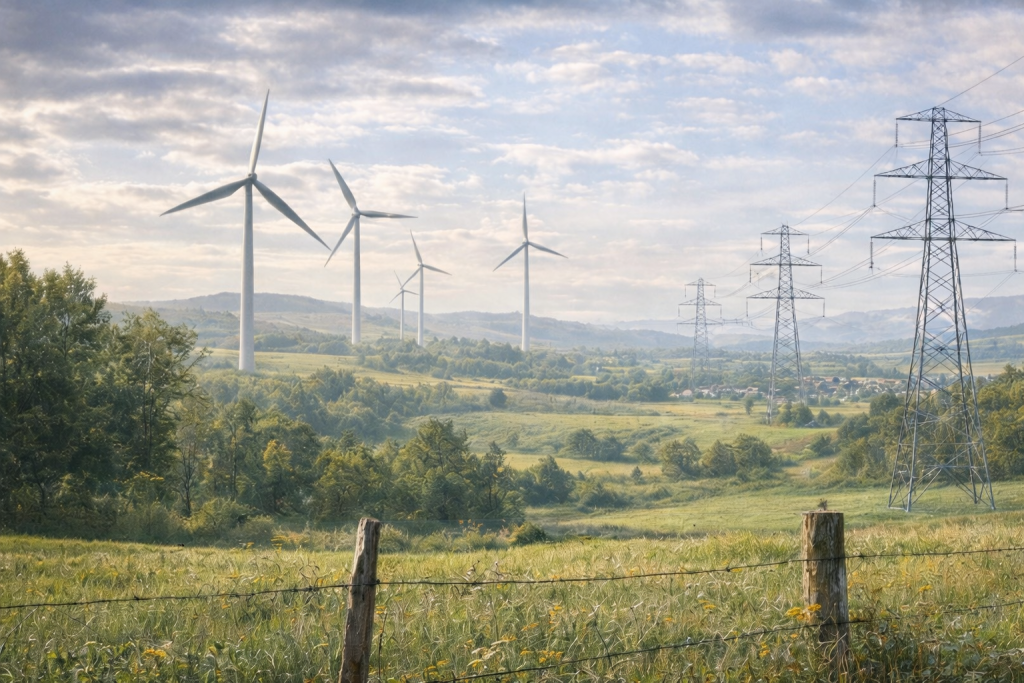
Grid expansion as an emissions driver
Transmission infrastructure is expanding rapidly to move electricity from dispersed generation sites to distant demand centres. Pylons, substations and underground cables are not neutral additions. They require land clearance, deep excavation and long construction programmes, often across rural and environmentally sensitive areas.
Electricity transmission also introduces losses. Energy dissipates as heat during transport and transformation. The further electricity travels and the more times it is converted, the greater the loss. This inefficiency means that more generation is required upstream to deliver the same usable output downstream.
From a carbon standpoint, inefficiency matters. It increases the volume of infrastructure needed and the emissions associated with it.
Oversupply and the logic of waste
Scotland already produces more electricity than it consumes. Additional generation therefore serves export markets rather than domestic need. When export capacity is constrained, electricity is curtailed. Generators are paid not to generate power they could otherwise produce.
Curtailment is not a technical failure. It is a structural feature of a system built around volume rather than balance. The carbon cost of building generation that cannot always be used is rarely acknowledged. Nor is the paradox that emissions are incurred upfront while benefits are conditional and partial.
Storage, safety and the compounding emissions cycle
As generation expands beyond domestic demand, storage has become the system’s pressure valve. Large Battery Energy Storage Systems are now being approved across Scotland at pace, frequently adjacent to rural settlements, farmland and sensitive landscapes. These facilities are often described as enabling infrastructure. In practice, they introduce a new layer of emissions and risk that reshapes the carbon balance rather than improving it.
Battery storage is materially intensive. Lithium based cells require energy heavy extraction, refining and manufacturing processes, most of which occur outside the UK and rely on fossil fuelled power. Those embedded emissions are fixed at the point of manufacture and recur with every replacement cycle. Grid scale batteries typically require renewal far sooner than wind or solar assets, meaning Scotland is locking itself into repeated waves of industrial manufacture and construction to maintain capacity that does not itself generate electricity.
Efficiency losses further complicate the picture. Energy stored and released through batteries is reduced at each stage of conversion. To deliver a unit of usable electricity downstream, more generation is required upstream. In an already oversupplied system, this drives further capacity build rather than restraint.
Safety considerations add a separate dimension. Thermal runaway events at large battery installations are well documented internationally, involving prolonged fires, toxic smoke and contaminated firefighting runoff. These are not abstract risks. They are operational realities that increase with scale and proximity to communities. Planning frameworks struggle to integrate these risks meaningfully, particularly where multiple sites are proposed across a single region.
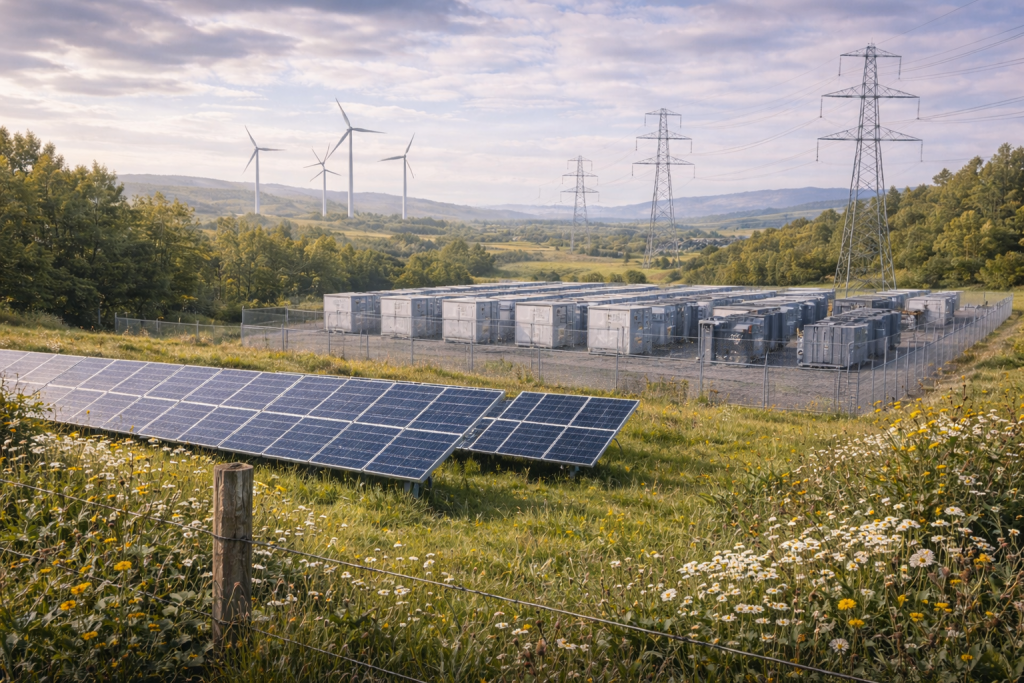
Solar expansion and land use conflict
Solar energy is often perceived as low impact compared to wind. Its land footprint tells a different story. Utility scale solar parks require extensive ground coverage, fencing, access routes, inverter stations and grid connections. They frequently occupy agricultural land, removing it from food production for decades.
From a carbon perspective, the displacement of productive land matters. Soil disturbance releases stored carbon, while the loss of local food production increases reliance on imports with associated transport emissions. Panels themselves degrade and must be replaced, reintroducing material extraction and manufacturing emissions into the system.
Solar therefore shares the same structural problem as other technologies in Scotland’s current strategy. Short to medium lifespans, repeated intervention and cumulative land take undermine claims of long term emissions reduction.
Rural Scotland as the system’s shock absorber
The physical consequences of this energy model are not evenly distributed. Rural and coastal communities carry the overwhelming burden of infrastructure density. Wind turbines dominate skylines. Pylons cut across fields and hills. Substations and storage compounds industrialise areas previously defined by agriculture, tourism and open space.
The impacts extend beyond aesthetics. Noise, vibration, light pollution and construction traffic affect daily life and health. Stress related to loss of place, uncertainty and cumulative development is increasingly reported by residents. These effects are rarely captured in project specific assessments that treat developments as isolated events rather than part of a regional transformation.
Economic effects are similarly uneven. Tourism relies on landscape character and perceived naturalness. Farming depends on contiguous land and biosecurity. Fragmentation by access tracks, cables and pylons reduces productivity and increases operational costs. These losses are diffuse and long term, while financial benefits are concentrated and often transient.
Legal fragmentation and the absence of a coherent plan
From a legal standpoint, one of the most striking features of Scotland’s energy expansion is the absence of a fully articulated, spatially coherent national energy plan. Development proceeds through individual consents under separate regimes for generation, storage and transmission. Cumulative impacts are acknowledged in principle but assessed weakly in practice.
This fragmented approach obscures systemic risk. It allows emissions to be counted at project level while ignoring the aggregate effect on carbon stores, land use and infrastructure churn. It also limits democratic accountability. Communities are consulted repeatedly on individual schemes without ever being asked whether the overall transformation is acceptable or necessary.
Decision making power remains centralised, while consequences are localised. The legal framework permits this imbalance but does not require it.
The circular logic of perpetual build
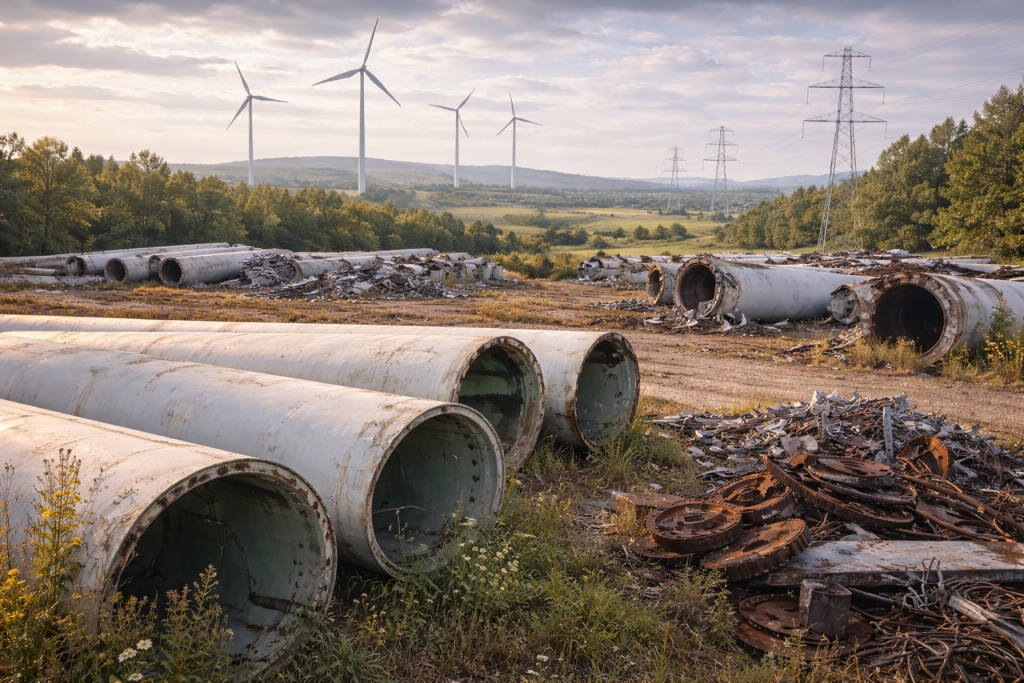
At the heart of the issue is a self reinforcing cycle. More generation creates oversupply. Oversupply drives the need for storage and export. Export requires grid expansion. Grid expansion enables further generation. Each step adds emissions, land disturbance and infrastructure that must eventually be replaced.
This is not a transition from high carbon to low carbon. It is a transition from combustion to construction, from fossil extraction to material extraction, with emissions displaced in time and space rather than eliminated.
Net Zero accounting struggles with this reality because it privileges annual operational emissions over cumulative ecological loss and infrastructure turnover. The result is a policy environment where Scotland can claim progress while eroding the foundations of its carbon advantage.
Who benefits and who bears the cost
The current trajectory is frequently justified in the language of national leadership and global responsibility. Yet the benefits to Scotland itself are limited. Electricity prices are set by wider markets. Energy security depends on system balance rather than raw capacity. Employment is often temporary and specialised.
What remains is a landscape increasingly dominated by industrial energy infrastructure, borne disproportionately by rural communities whose voices carry the least weight in national policy.
The evidence suggests that without a fundamental shift in approach, Scotland’s energy strategy will continue to increase real world emissions, degrade natural carbon stores and entrench a cycle of perpetual construction. The question now facing policymakers is not whether renewable energy should form part of Scotland’s future, but whether the current model is compatible with environmental protection, social equity and genuine emissions reduction.
Public health, place and the lived reality of energy saturation
As energy infrastructure density increases, its effects extend beyond land take and emissions accounting into public health and social wellbeing. These impacts are not incidental. They are structural consequences of concentrating industrial development in rural environments that were never designed to absorb it.
Noise from turbines, substations and associated equipment is persistent rather than episodic. Low frequency noise, tonal characteristics and cumulative background sound alter living conditions even where formal thresholds are technically met. Light pollution from aviation lighting, security systems and night time maintenance activity erodes dark skies that are increasingly recognised as a public health asset. Construction brings years of heavy vehicle movements, dust and vibration, disrupting sleep, mobility and daily routines.
From a legal and medical perspective, these factors contribute to stress related health effects. Loss of control, uncertainty created by rolling planning applications, and the gradual erosion of familiar landscapes affect mental wellbeing. These outcomes are difficult to quantify within individual project assessments but are well understood in public health research dealing with environmental stressors.
Once infrastructure is embedded, these conditions persist for the lifetime of the assets and often beyond, as replacement and upgrading cycles restart disturbance.
Tourism, landscape value and economic contradiction
Scotland’s rural economy depends heavily on landscape quality, perceived wildness and environmental authenticity. Tourism is not an abstract benefit. It supports employment, local businesses and community resilience across large parts of the country.
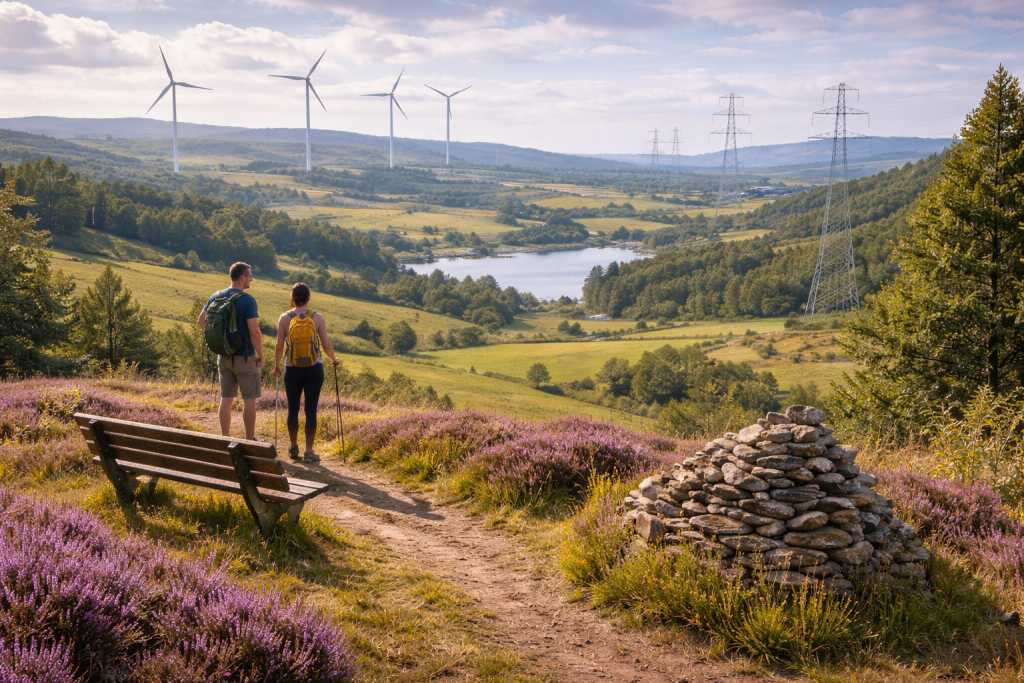
The cumulative industrialisation of landscapes undermines this foundation. While a single development may be described as visually acceptable, the combined effect of turbines, pylons, substations, solar arrays and storage compounds alters the character of entire regions. The result is not transition but transformation.
This creates a contradiction at the heart of energy policy. The same landscapes promoted internationally as symbols of Scotland’s natural heritage are being incrementally converted into energy corridors. Economic gain from energy generation does not compensate locally for the long term erosion of tourism appeal, particularly where visitor decisions are based on perception rather than technical planning judgments.
Farming, food security and land fragmentation
Agriculture is another sector experiencing indirect but significant pressure. Wind farms, solar parks and grid infrastructure fragment holdings, reduce usable acreage and complicate land management. Access tracks, cable easements and exclusion zones break continuity, increasing costs and reducing efficiency.
Solar development on productive farmland removes land from food production for decades at a time. This displacement is rarely framed as a carbon issue, yet it carries emissions consequences through increased food imports and transport. Farming also plays a role in maintaining peatland hydrology and landscape stewardship. Fragmentation weakens that role.
These losses accumulate gradually, often unnoticed in national statistics but acutely felt at farm level.
The absence of informed consent
Perhaps the most striking feature of Scotland’s current energy trajectory is how little of it has been openly debated as a single, coherent plan. Communities are consulted repeatedly on individual proposals but are never asked to consent to the aggregate outcome.
From a legal perspective, this raises questions of procedural fairness. Environmental decision making is meant to consider cumulative effects and reasonable alternatives. In practice, the absence of a transparent, spatially defined national energy strategy allows each new development to be justified by reference to targets rather than need.
Targets do not explain why specific places must absorb specific levels of infrastructure. They do not explain why peatlands are sacrificed while emissions are counted elsewhere. They do not explain why rural communities shoulder impacts for benefits that are neither local nor guaranteed.
A flawed strategy built on flawed assumptions about technology
It is often argued that the problem lies not with renewable technologies themselves, but with how they are deployed. That distinction does not fully withstand scrutiny. The reality is that much of the current energy infrastructure being rolled out across Scotland is intrinsically limited by short operational lifespans, material intensity and dependence on continual replacement. These are not peripheral issues. They are fundamental characteristics of the technologies being relied upon.
Wind turbines are not long-term assets in the conventional sense. Most are designed for operational lives of around twenty to twenty five years under ideal conditions. Solar panels degrade steadily and require replacement well within the timescales assumed by climate targets. Grid scale battery storage systems have even shorter functional lives, often closer to a decade before significant loss of capacity necessitates renewal. Each replacement cycle repeats the carbon costs of manufacture, transport, construction and land disturbance.
This matters because Net Zero accounting implicitly assumes permanence. Emissions are treated as front loaded costs offset by decades of low carbon operation. Where infrastructure must be rebuilt repeatedly, those assumptions collapse. The carbon debt is not paid down. It is rolled forward and compounded.
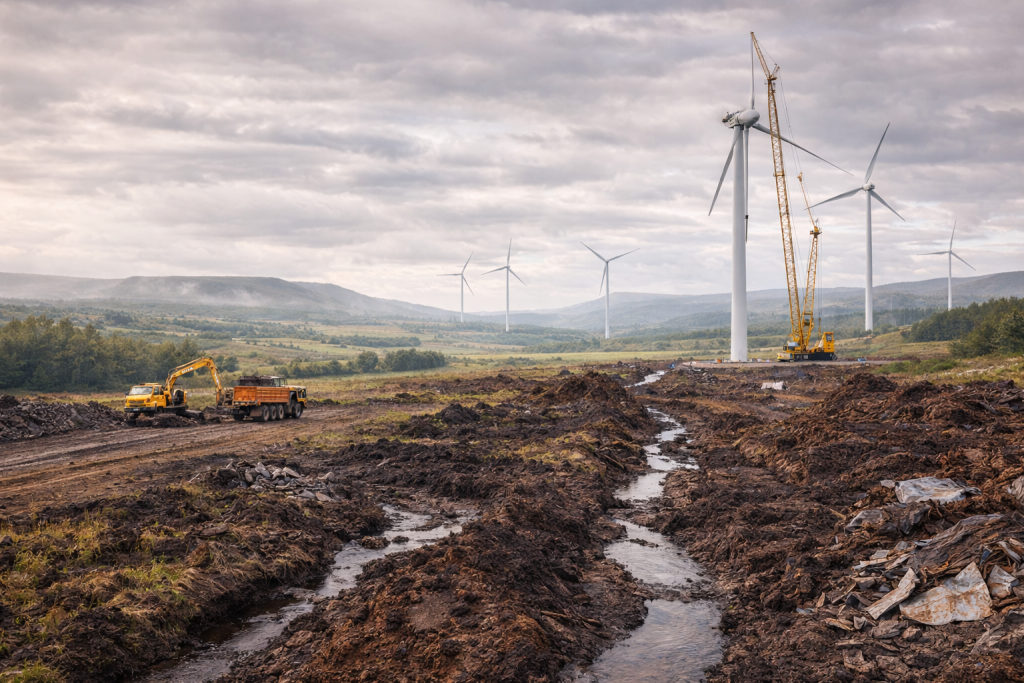
When such technologies are placed on carbon rich land, particularly peatland, the flaw becomes systemic. Peat disturbed once does not recover within policy timescales. Peat disturbed repeatedly becomes a chronic emissions source. A technology that depends on continual reconstruction in these environments cannot credibly be described as low carbon over its full lifecycle, regardless of how its electricity output is labelled.
The strategy compounds this weakness by pursuing scale without restraint. Short lived technologies are multiplied across landscapes already under pressure, locking Scotland into a future of perpetual construction. The environmental cost is ongoing. The emissions cost recurs. The social impact intensifies with each renewal cycle.
This is not a failure of execution alone. It is a failure of premise. A transition built on infrastructure that must constantly be rebuilt, expanded and replaced cannot deliver stable, long term emissions reduction. It replaces fossil dependence with material dependence and combustion emissions with construction emissions.
Until policy acknowledges the finite lifespan and cumulative carbon cost of the technologies it promotes, Scotland will remain trapped in a cycle where environmental harm increases even as climate targets are declared met.
Why calls for a moratorium are growing
Against this backdrop, it is no surprise that large scale energy developments across Scotland are now being met with sustained and widespread objection. Communities, environmental groups and independent experts are not rejecting the need for an energy transition. They are questioning the absence of a credible plan to govern it.
Calls for a moratorium have emerged precisely because the current approach proceeds without resolving its core contradictions. Projects continue to be consented before the true carbon costs of construction, replacement cycles and peatland degradation are fully accounted for. Developments are assessed in isolation while cumulative impacts on landscapes, ecosystems and public health are repeatedly minimised or scoped out. Rural communities are asked to absorb industrial scale change without clarity on national benefit, long term necessity or environmental limit.
A moratorium is not an attempt to halt progress. It is a demand for pause and coherence. Campaigners are calling for a transparent national energy strategy that starts with protection of Scotland’s natural carbon stores, places public health and wellbeing at the centre of decision making, and honestly evaluates lifecycle emissions rather than relying on theoretical savings. Until those conditions are met, continuing the current onslaught risks locking Scotland into a cycle of environmental loss and carbon leakage that directly undermines its climate ambitions.
Scotland does need an energy transition. What it does not need is one that sacrifices peatlands, landscapes and communities while claiming success through accounting mechanisms that ignore real world damage.
A pause to reassess is not a retreat from Net Zero, and it is the only credible way to reach it.


One Reply to “Scotland’s Expanding Energy Infrastructure and Its Carbon Impact”
Barbara Keane
Excellent report.