
What Changed? The Questions Scotland’s Energy Consents Unit Still Needs to Answer
Avg Read Time: 15 – 20 mins
Questions Still Remain Unanswered
For years, members of the public could submit representations on major energy developments to the Scottish Government’s Energy Consents Unit by email. It was a familiar and flexible route, allowing people to prepare their representations using their own software and accessibility tools before sending them electronically to the authority responsible for processing them.
On 16 January 2026, that changed. Email ceased to be an accepted route for public representations on onshore applications handled by the ECU. Members of the public were instead directed towards the Energy Consents portal, while the considerably more traditional option of sending a representation by post remained available.
Recent reporting by The Ferret, based upon Scottish Government correspondence already obtained and released through earlier Freedom of Information requests, has placed that decision in a much wider context. The previously disclosed material records discussions about AI-assisted representations, increasing volumes of objections and the administrative burden associated with processing them.
It also reveals something particularly important. Almost a year before email was removed, the ECU had already examined how the objection platform being operated through ObjectNow for the Glenvernoch Wind Farm application worked.

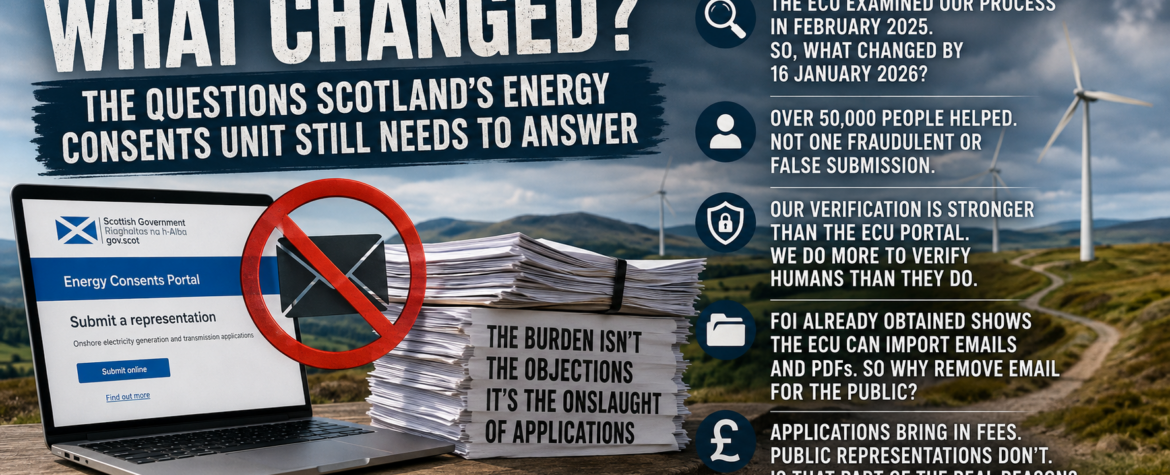
That leaves a question which, in our view, has still not been adequately answered: if the ECU had already examined the process through which people were submitting ObjectNow-assisted representations in February 2025, what changed by 16 January 2026?
The ECU Had Already Examined the Process
The February 2025 correspondence concerns the Glenvernoch Wind Farm application and the Hands Off Our Hills objection platform operated using ObjectNow. After AI-assisted representations became a subject of discussion, the ECU examined the steps members of the public followed when using the platform.
The correspondence records that individuals entered their own personal details, completed human verification, selected the grounds of objection they wished to raise and personally submitted their representations. The ECU also made an important distinction about how those representations would be considered: the material issues raised within individual representations mattered, rather than simply the number received.
That distinction is fundamental. ObjectNow has never argued that planning or consenting decisions should be determined by counting objections. A development attracting 10,000 objections is not automatically refused, just as one attracting relatively few objections is not automatically approved. What matters is the substance of those representations and the relevant issues they raise.
The significance of the February 2025 correspondence is therefore not that the ECU endorsed every objection or every argument produced through the platform. It is that officials examined how the system operated and recognised a process involving individual members of the public providing their details, completing verification, choosing the matters they wished to raise and submitting their own representations.
Eleven months later, the electronic submission route which enabled that process had been removed.
ObjectNow Is Not an AI Objection Generator
Much of the debate surrounding AI-assisted representations appears to be based on a fundamental misunderstanding of what ObjectNow actually does.
ObjectNow is not a general-purpose AI service where somebody enters the name of a development and asks artificial intelligence to invent an objection. Every campaign begins with foundation material researched, written and reviewed by humans. Application documents and Environmental Impact Assessment material are examined alongside relevant legislation, adopted policy and supporting evidence before the platform is made available to the public.
Artificial intelligence then performs a deliberately restricted role. It works from that prepared foundation material to help assemble a representation around the concerns selected by the individual. It is not instructed to independently research the development, invent additional planning arguments or introduce whatever interpretation it chooses. This structure is specifically designed to minimise the risks associated with unrestricted generative AI, including inaccurate information and hallucinations.
The individual remains responsible for their representation.
They decide to participate, provide their details, verify themselves, select the issues which genuinely concern them, review what has been produced, make changes where necessary and decide whether the completed representation reflects their own views.
ObjectNow provides assistance. It does not replace the person making the representation.
More Than 50,000 People, So Where Is the Evidence of Fraud?
ObjectNow has assisted more than 50,000 people across the United Kingdom to participate in planning and consultation processes. Across that entire body of participation, we have not been notified of a single substantiated case in which an ObjectNow representation was established to have been fraudulently submitted in another person’s identity, falsely attributed to somebody who had not made it, or autonomously submitted by a bot pretending to be a member of the public.
That does not mean we believe any system is incapable of abuse. No responsible organisation should make such a claim. It does mean that allegations or implications of fraudulent participation should be supported by evidence, particularly where concerns about authenticity or integrity are being relied upon to justify restrictions affecting every member of the public.
Previously disclosed FOI documentation is particularly relevant here. Where questions have arisen about the authenticity of individual representations, it is important to establish how those representations were submitted, what system processed them and whether ObjectNow had any involvement. A problem arising through another submission route cannot reasonably be presented as evidence that ObjectNow created an integrity problem.
This is also why our own recent information request specifically asks the Scottish Government to provide any evidence it holds of fraudulent ObjectNow submissions, false identities, automated submissions or representations believed not to have originated from genuine individuals.
If that evidence exists, we want to see it. If a weakness is identified in our platform, we want to understand it and address it. If no such evidence exists, that is equally important.
Our Verification Has Become Stronger, Not Weaker
The ObjectNow platform operating today contains considerably more verification and anti-abuse protection than the system examined by the ECU in February 2025.
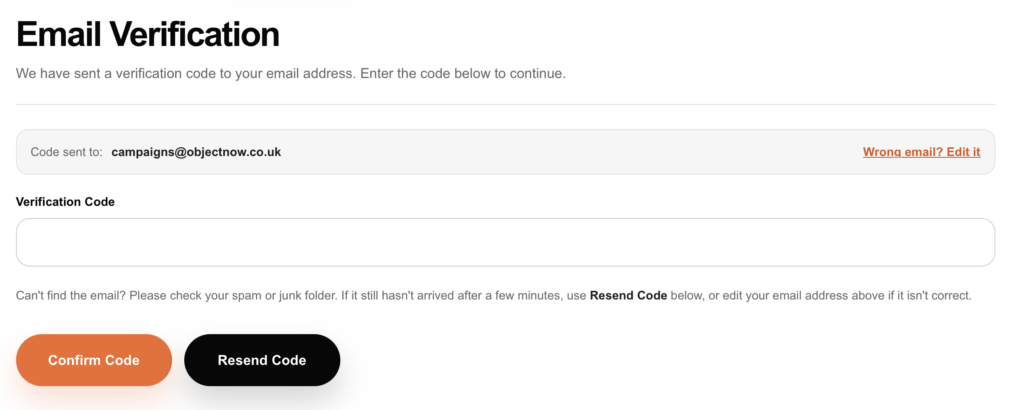
Our current process uses multiple safeguards, including verification of access to the email address supplied by the user, human and bot detection, duplicate-submission controls, rate limiting and behavioural measures intended to identify suspicious or automated activity. Verification alone cannot submit an objection. The individual must progress through the process, make their own selections, review their representation and actively decide to submit it.

In terms of user-facing verification and anti-automation measures that can reasonably be compared, ObjectNow now applies safeguards beyond those visibly required when somebody submits a representation through the ECU portal.
Having examined the public-facing ECU process, we can see that it uses CAPTCHA protection and email verification. These are established baseline security measures designed to provide a level of protection against automated submissions and to confirm access to the email address provided.
What cannot be determined from the public-facing system is what happens beyond those measures. We cannot see whether the ECU employs additional behavioural bot detection capable of identifying automation that has circumvented the CAPTCHA, whether repeated or suspicious submission patterns are automatically detected, or whether controls exist to identify and restrict somebody attempting to submit multiple duplicate representations.
We therefore cannot, and would not, claim knowledge of every security control operating behind the Scottish Government’s systems. It would be inappropriate to state categorically that ObjectNow is more secure overall when we do not have access to the ECU’s underlying security architecture.
What we can compare are the safeguards that are visible and those we know ObjectNow applies. ObjectNow does not rely solely upon CAPTCHA and email verification. Our platform incorporates additional layers of protection specifically intended to identify automated behaviour, repeated or suspicious activity, duplicate submissions and attempts to circumvent normal submission controls.
These safeguards work alongside our verification process rather than replacing it. Their purpose is not simply to establish that somebody has access to an email address, but to provide greater assurance that a genuine person is actually progressing through the objection process, making deliberate choices and personally deciding to submit the resulting representation.
That distinction is important. No online system can credibly claim that abuse is impossible, and we make no such claim. Our objective is to make automated or fraudulent participation progressively more difficult through multiple independent safeguards rather than relying upon any single security measure.
That investment has been made for a straightforward reason. When a representation leaves ObjectNow, we want the strongest practicable assurance that there is a genuine individual behind it who has deliberately chosen to participate and that the submission has not simply been generated or submitted autonomously by a bot.
We Asked the ECU to Work With Us
There is another important part of this chronology.
When the arrangements changed in January 2026, ObjectNow did not simply criticise the ECU or look for ways around its new system. We contacted the ECU and asked how our platform could be modified so that we could work with its requirements rather than against them.
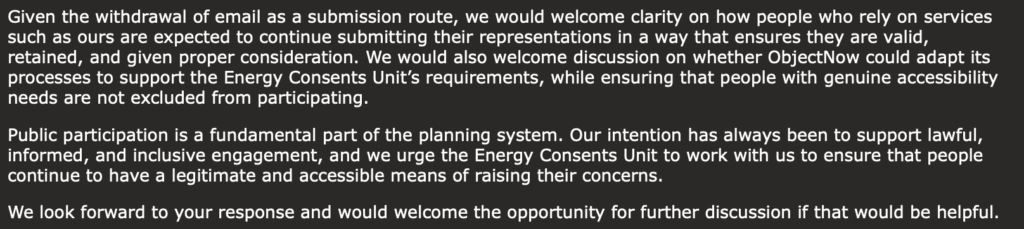
If additional verification was required, we wanted to understand what standard was expected. If representations needed to be supplied in a particular electronic format, we were prepared to consider it. If officials had concerns about bots, duplicate submissions, identity verification or security, we wanted those concerns explained so that we could determine whether they could be addressed technically.
We received no response to that offer.
That is difficult to reconcile with an argument centred upon protecting the integrity of public representations. If a platform helping substantial numbers of people participate approaches the authority administering the process and offers to implement reasonable additional safeguards, constructive engagement would appear to be the obvious starting point.
Our offer remains open.
We are prepared to demonstrate exactly how ObjectNow operates, explain our security measures and consider reasonable technical modifications which would allow ObjectNow and the ECU’s systems to work alongside one another.
The ECU Already Has Tools for Electronic Material
FOI documentation obtained through earlier requests raises an important question about the technical justification for removing email.
The disclosed material shows that the ECU’s administrative system contains functionality for importing electronically received material, including emails and PDF documents.
This evidence comes from previous FOI disclosures and is separate from ObjectNow’s more recent information request, which remains outstanding.
That existing functionality is significant because ObjectNow could provide representations in a format specifically designed to reduce, rather than increase, the administrative work required of ECU staff. Each representation could, for example, be supplied as a publication-ready PDF with personal information already redacted, accompanied separately by the identifying information required by the ECU to register and process the representation.
The public version would therefore arrive ready for import without officials having to manually redact the document before publication.
Much of the processing work could consequently be completed before the representation ever reached the ECU. With an agreed technical process, receiving an ObjectNow representation electronically could potentially become a straightforward administrative task rather than an additional burden.
We were prepared to discuss precisely this kind of arrangement when we contacted the ECU in January 2026 and asked how ObjectNow could adapt to work with its requirements.
That is why the decision to remove email deserves further explanation. If formatting or data handling was causing difficulties, the ECU already appears to have had tools capable of importing electronic documents and ObjectNow was prepared to adapt the format in which those documents were supplied.
If verification was the concern, an appropriate verification standard could have been discussed and incorporated into our platform. If administrative workload was the problem, an automated or streamlined import process could at least have been explored before an established method of public participation was withdrawn.
We are not suggesting that electronic representations require no administration. They still need to be registered, processed and considered appropriately. The issue is whether removing email for everyone was a proportionate response when the technology for importing electronic material already existed and an organisation responsible for facilitating thousands of representations was actively offering to work with the ECU to make that process more efficient.
Rather than closing the electronic route, there was an opportunity to examine how the existing technology, appropriate verification standards and pre-processed electronic documents could work together.
The fact is: the opportunity was never explored with us.
That leaves a much simpler question: if the ECU already had the technical ability to import emails and PDFs, and ObjectNow was prepared to adapt its system to reduce the administrative work involved, why was the solution to remove email rather than improve the way electronic representations were received and processed?
The answer becomes even more difficult to understand when the alternative that remains available is considered: sending the same representation to the ECU on paper through the post.
The Postal Alternative Exposes the Contradiction
The ECU continues to permit representations by post. ObjectNow could therefore, in principle, redesign its process so that completed representations were printed and hundreds or potentially thousands of individual letters were physically sent to the ECU.
We have deliberately chosen not to do that because we believe it would be counterproductive.
Information which already exists digitally would have to be printed, placed in envelopes, posted, physically received and then administratively handled. It would create unnecessary cost, paper consumption and would 100% increase the workload for ECU staff without making a single representation more authentic.
We have no intention of deliberately creating that burden simply because the rules technically permit us to do so.
Nevertheless, the existence of the postal option exposes an obvious contradiction. A member of the public can print a representation, put it in an envelope and send it to the ECU, but cannot send the same document electronically through the email route that existed before 16 January 2026.
That becomes particularly difficult to understand when previously disclosed FOI documentation shows that the ECU’s administrative system itself has functionality for importing electronic material.
If administrative efficiency was an important reason for reforming the system, it is entirely reasonable to question why physical correspondence remains acceptable while an established digital route does not.
There appears to be an obvious middle ground: retain the ECU portal for those who wish to use it, restore email as an alternative electronic submission route, and establish proportionate verification and formatting standards for electronically submitted representations via ObjectNow, so people can decide for themselves how they wish to submit their representations to the ECU.
The Burden Does Not Begin With the Objections
This is perhaps the most important distinction in the entire debate.
Objections do not simply materialise. They exist because applications have been submitted which people wish to support, oppose or comment upon.
Across Scotland, communities are being asked to engage with a substantial programme of energy infrastructure development. Some areas face wind farms, overhead transmission lines, substations, battery storage and associated infrastructure simultaneously, with each application potentially accompanied by thousands of pages of environmental and technical documentation. Communities which have already spent considerable time and money engaging with one proposal can also find themselves facing revised or subsequent proposals affecting the same area.
That context matters when the volume of representations is described as an administrative burden.
The workload does not suddenly begin when somebody submits an objection. It begins with the volume, scale and complexity of applications entering the consenting system and the statutory processes those applications generate.
Every major application creates work for the ECU, statutory consultees, local authorities and other public bodies. It creates substantial work for communities too. Ordinary people spend evenings and weekends reading environmental reports, examining maps, attending consultations and preparing representations. Some communities raise thousands of pounds to commission their own professional landscape, ecological, noise, planning or legal advice.
ObjectNow did not create that workload. Neither did the people submitting objections. Their representations are a consequence of applications entering the consenting system.
Developers are entitled to submit applications where the law permits them to do so, just as members of the public are entitled to participate in the process which follows. But if the scale and complexity of development being processed creates a corresponding increase in public representations, it is wrong to examine those representations in isolation as though they are the source of the administrative pressure.
If Scotland’s consenting system is becoming overwhelmed, the starting point for examining that pressure should therefore be the number, scale and complexity of applications entering it, not the number of people exercising their opportunity to respond.
A system struggling to process legitimate public participation has a capacity problem. Legitimate public participation is not the problem.
The Question of Application Fees
There is another distinction which deserves scrutiny.
Applicants pay statutory fees for certain applications made under the Electricity Act 1989. The Scottish Government has previously linked its fee regime to recovering the costs associated with administering the consenting service. Members of the public, quite properly, do not pay the Government to make representations.
That creates an uncomfortable but legitimate question:
If increasing application numbers and increasing public representations both create additional work for the ECU, why has the policy response focused upon controlling the route through which the public submits representations rather than examining the volume, scale and administrative consequences of applications entering the system?
There is an obvious financial distinction between the two. Applications generate fee income. Public representations do not.
Has that financial distinction played any part whatsoever in the approach taken to managing ECU workload?
We currently have no evidence that it has, and we are not alleging that the Scottish Government allows applications to continue because of the income they generate. That would be a serious conclusion requiring evidence which we do not presently possess.
But the question is legitimate if administrative burden is being relied upon as part of the justification for changing the way public participation is managed. If capacity is genuinely the problem, the Scottish Government should be able to explain transparently how application volumes, application fees, ECU staffing and resources, representation volumes and processing requirements have each been considered.
The public should not become the easiest part of the system to restrict simply because their participation does not generate revenue.
A Portal Is Not Necessarily an Equivalent Replacement
The Scottish Government can correctly say that people remain able to object. The important question is whether the replacement arrangements provide an equally effective and accessible opportunity to participate.
Email allowed someone to prepare a representation using their own software, accessibility tools and working methods before transmitting the completed document electronically. A prescribed portal determines the structure through which information is entered, the technical limits which apply and the period during which that functionality is available for a particular application.
This matters particularly for people with disabilities, neurodivergent people, those with literacy difficulties and people unfamiliar with environmental consenting. Accessibility is not simply about whether somebody can open a webpage. It is about whether they can use the process effectively enough to participate meaningfully.
There is also a wider evidential imbalance. Major developers routinely submit extensive Environmental Impact Assessment Reports accompanied by technical appendices, photographs, maps, visualisations, modelling and specialist reports. Communities may need photographs, mapping or independently commissioned professional evidence to explain why they disagree with those assessments.
Applicants and objectors plainly have different procedural obligations. Fairness does not require those obligations to be identical. It does, however, require members of the public to have a meaningful opportunity to place relevant representations and evidence before the decision-maker.
A public participation system should therefore be judged not merely by whether it provides somewhere to type text, but by whether it allows people to present their case effectively.
What Happens When New Information Appears?
The portal-based approach also creates practical questions as applications evolve.
Developers can submit further material after an original consultation period has ended. There is no unrestricted legal “right to reply” to every document subsequently uploaded, and we do not suggest otherwise. There are, however, specific statutory requirements governing additional environmental information under the Electricity Works (Environmental Impact Assessment) (Scotland) Regulations 2017.
Where qualifying additional environmental information is submitted, further publicity and consultation requirements can apply. That reflects an important principle: where relevant environmental information forming part of the decision-making process is supplemented in circumstances caught by the Regulations, the public must be provided with the corresponding statutory opportunity to participate.
The practical concern arises when other documents appear during a live application after the original representation period has closed but there is no obvious open portal mechanism through which somebody can make further comments. Members of the public can then be left uncertain about whether further representations can be made and, if they can, how those representations should reach the ECU.
A modern digital system should make lawful public participation easier to understand, not create additional uncertainty around when and how people are permitted to engage.
Has Public Participation Fallen?
Since email was removed, we have observed what appears to be a marked reduction in the number of representations being submitted on some developments compared with major campaigns conducted under the previous arrangements.
That observation needs to be treated responsibly. Different developments generate different levels of public interest, and their location, scale, environmental effects, publicity and local campaigning can all affect the number of representations received. Comparing two projects and attributing any difference solely to the portal would not provide reliable evidence.
What should be possible is a proper examination of participation across the system before and after 16 January 2026. If an established electronic submission route is removed and public participation subsequently falls materially, the Scottish Government should itself want to know whether the change contributed to that reduction.
That question becomes particularly important when considered alongside the previously disclosed discussions about increasing representation volumes and the administrative resources required to process them.
There is an important difference between saying that Government needs a better system for processing large-scale public participation and concluding that there is too much public participation. The first is an administrative problem capable of being solved. The second would raise much more serious questions about the purpose and integrity of public consultation.
The Existing FOI Evidence and Our New Request Are Different
It is important to distinguish between two separate sets of information.
Much of what has prompted the questions in this article comes from FOI documentation already obtained through earlier requests by campaigners and subsequently brought into the public domain, including material reported by The Ferret. That existing evidence includes the February 2025 discussions concerning the Glenvernoch platform and other information which has allowed the public to see at least part of the Government’s internal consideration of AI-assisted representations and public participation.
ObjectNow has now separately submitted its own comprehensive information request, dated 6 August 2026, under the Environmental Information (Scotland) Regulations 2004 and, where applicable, the Freedom of Information (Scotland) Act 2002.
Our request seeks to go considerably further. We have requested the wider documentary record concerning ObjectNow and campaigns using our platform, communications with applicants and developers, discussions about AI-assisted representations, the evidence informing changes to submission procedures and any recorded examples of fraudulent, false or automated submissions associated with our service.
We have asked for that information because speculation is unnecessary when the Scottish Government possesses the records capable of answering many of these questions.
If bots were submitting ObjectNow representations, provide the evidence. If people’s identities were being fraudulently used, identify the cases. If officials discovered a vulnerability in our verification system, tell us what it was. If there was a legal or technical problem with receiving representations by email, explain it.
Our new request is therefore not the source of the evidence discussed throughout this article. It is the next stage in trying to establish the complete documentary record behind decisions which have already been partly exposed through earlier disclosures.
When the Scottish Government responds, we will examine what is disclosed and report on what it actually establishes. If the evidence identifies a genuine weakness in our system, we will address it.
If no such evidence exists, that is equally relevant.
So, What Changed?
This is ultimately why the documents already obtained matter.
In February 2025, the ECU examined the Glenvernoch objection platform and recorded a process in which individual users provided their details, completed human verification, selected their objection grounds and submitted their own representations.
During the following months, ObjectNow strengthened its verification and anti-abuse measures further. When the submission arrangements changed in January 2026, we approached the ECU and asked how our platform could be adapted to work with its requirements. We received no substantive response.
FOI documentation already obtained through earlier requests also shows functionality within the ECU’s own administrative system for importing electronic material, including emails and PDFs.
Yet on 16 January 2026, email ceased to be an accepted route for public representations.
That sequence of events requires an explanation. If significant new evidence emerged between February 2025 and January 2026, the Scottish Government should explain what it was. If the problem was fraud, demonstrate it. If it was security, identify the vulnerability. If it was verification, explain why proportionate verification requirements could not address it. If it was technology, explain why the electronic tools already available could not be adapted.
If the problem was administrative capacity, however, a much wider question has to be answered. Why was attention directed towards the volume of public representations rather than the number, scale and complexity of applications generating them?
And because applications generate fee income while public representations do not, the Scottish Government should also be prepared to answer whether that financial distinction played any part whatsoever in how competing administrative pressures were treated. We are not alleging that it did. We are asking the question and seeking the evidence necessary to answer it.
ObjectNow remains willing to work with the ECU. We are prepared to demonstrate our platform, discuss additional safeguards and make reasonable technical changes where they genuinely improve integrity and security.
What we cannot accept is the proposition that increasing numbers of genuine people participating in the consenting process should itself be regarded as a problem requiring their routes of participation to be narrowed.
More than 50,000 people have used ObjectNow to participate in planning and consultation processes across the United Kingdom. Not one substantiated fraudulent or false ObjectNow submission has been brought to our attention.
If the Scottish Government holds evidence to the contrary, our new information request gives it the opportunity to provide it.
The principle at stake is straightforward:
The consenting system must have sufficient capacity to accommodate legitimate public participation. Legitimate public participation should not be constrained simply to accommodate the capacity of the consenting system.
Until the remaining records are disclosed, the central question remains unanswered:
If the ECU had already examined the process through which people were submitting ObjectNow-assisted representations in February 2025, what changed by 16 January 2026?
Sadly, what remains difficult to ignore is the apparent connection between the increasing number of public objections being submitted to major developments, including projects such as SSEN’s 400kV overhead line proposals in the Highlands, and the subsequent concern within Government about the volume of representations being received.
However burdensome those numbers may have been administratively, legitimate public participation should never have been treated as a problem to be reduced. It should not have provided a justification for removing email as an established means of submitting representations, nor for creating barriers which prevented people from continuing to use ObjectNow to exercise their right to participate.
If thousands, or tens of thousands, of genuine people wish to object to a development, the appropriate response is to ensure the consenting system has the capacity to process those representations fairly and efficiently.
The number of people choosing to have their say should never determine how easy or difficult Government makes it for them to do so.

One Reply to “What Changed? The Questions Scotland’s Energy Consents Unit Still Needs to Answer”
G Aitken
Completely agree. One FOI request which may have been made (but if I can’t find it I will ask it) is how many applications considered by the ECU have been consented, how many have been refused and if both, how many decisions have been taken to appeal and either allowed or quashed.