
Fact Check: SNP’s ‘One-Third Off’ Energy Bill Claim Lacks Evidence, Analysis Reveals
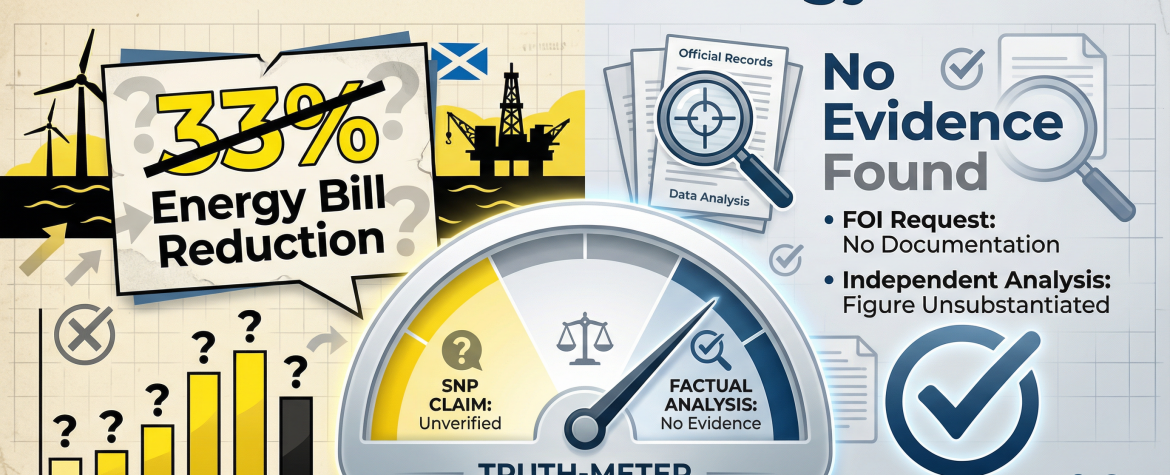
A prominent SNP campaign claim states that Scottish independence would cut “household electricity bills by over a third”, and separately that it would cut “household energy bills by over a third”. [1]
Because this is presented as a specific numerical outcome rather than a broad ambition, it can be assessed against the structure of household energy bills and the publicly available evidential record.
The Claim and the Public Record
The Scottish National Party campaign page titled “It’s Scotland’s Energy” states that independence would:
“Cut household electricity bills by over a third”
“Cut household energy bills by over a third.” [1]
The claim has also been reported in national media coverage of statements by senior SNP figures, including reporting that independence could reduce energy bills by more than a third. [2]
Given the specificity of the percentage reduction, a documented calculation or analytical model would ordinarily underpin such a claim.
A Scottish Government Freedom of Information entry (FOI/202500488970) relates directly to requests for evidence supporting “lower energy bills” statements. The published entry notes that the referenced paper “does not explain how energy bills would be lowered” and sought any explanation and supporting evidence held. [3]
Under the Freedom of Information (Scotland) Act, public authorities must disclose recorded information they hold at the time of a request. They are not required to create new analysis in response to a request. [4]
The published FOI material does not include a disclosed recorded calculation explaining how the “over a third” figure was derived. As a result, no publicly available, auditable model accompanies the headline claim.
How Household Energy Bills Are Structured
Household energy prices in Great Britain are governed by the Ofgem Default Tariff Cap. [5] Bills are composed of multiple cost components, not simply the cost of renewable generation.
A House of Commons Library briefing provides an illustrative breakdown of a typical domestic bill under the price cap. [6]
These components include:
- Wholesale energy costs
- Network (transmission and distribution) costs
- Policy and environmental costs
- Operating, debt and industry costs
- VAT (5% on domestic energy)
- Supplier margin
Wholesale costs are significant, but they are not the entirety of the bill. Network charges, policy costs and operating costs form a substantial structural floor.
Even if wholesale electricity costs were materially reduced, the full household bill would not fall proportionately unless the remaining components were also reduced or funded elsewhere.
A claim of “over a third” off household bills therefore requires clear specification of which bill components would fall, by how much, and through what mechanism.
Electricity Bills vs Total Energy Bills
A further issue is the distinction between electricity-only bills and total household energy bills.
The Scottish House Condition Survey 2023 confirms that mains gas is the most common heating fuel in Scotland, used by 81% of households. [7]
For most homes, winter energy expenditure is driven primarily by gas consumption for space heating. Scotland’s renewable electricity output does not determine wholesale gas prices, which are influenced by wider commodity markets.
Therefore, a claim that total “energy bills” would fall by more than one third would require a defined mechanism to reduce gas-related costs, gas network charges or associated levies, or a rapid displacement of gas heating at scale. No publicly disclosed calculation accompanying the headline claim explains how this would occur.
Renewable Generation and Wholesale Pricing
Scotland generates a high proportion of renewable electricity and is a net exporter in annual terms. However, retail prices are shaped by wholesale market rules.
In the integrated Great Britain wholesale market, electricity prices are set using marginal cost pricing. The most expensive generation required to meet demand sets the wholesale price in each settlement period. [8] Gas-fired generation frequently sets the marginal price, meaning wholesale electricity prices are strongly influenced by gas prices. [9]
This market structure means that high renewable output does not automatically result in proportionately lower retail tariffs under existing rules.
Export revenues accrue to generator owners under contractual frameworks. For households to see a direct reduction, a government would need to implement a defined intervention, such as mandating discounted domestic supply or redistributing revenues via taxation. No publicly disclosed costed model demonstrates that such interventions would produce a sustained reduction of over one third after infrastructure and system costs are considered.
The Fiscal Dimension
Significant reductions in household energy bills in recent years have been achieved through fiscal intervention.
The National Audit Office reported that domestic and non-domestic energy bills support schemes introduced between 2022 and 2024 were estimated to cost £44 billion, with the Energy Price Guarantee representing the largest share of expenditure. [10]
That precedent demonstrates that large reductions at the point of payment require substantial public expenditure.
Any guarantee of a one-third reduction would therefore require:
- A transparent cost estimate
- A defined funding route
- An assessment of long-term fiscal sustainability
No published model accompanying the headline claim provides this level of financial detail.
Conclusion: An Unsubstantiated Claim
The claim that Scottish independence would reduce household electricity bills by “over a third”, and in some representations total “energy bills” by over a third, is presented as a definitive numerical outcome.
The publicly available record does not include a disclosed calculation explaining how that figure is derived. The relevant Scottish Government FOI entry records that the referenced paper did not explain the mechanism and sought supporting evidence held.
Separately, the structure of domestic energy bills under the Ofgem price cap demonstrates that large portions of household bills consist of network charges, policy costs, operating costs and VAT, not wholesale electricity alone. Scotland’s heating profile further complicates claims regarding total energy bills because gas remains dominant.
Without a transparent, documented model specifying which bill components fall, how costs are removed or redistributed, and what the fiscal implications are, the “over a third” figure cannot be treated as a verified, costed consumer outcome.
As presented, it remains a numerical assertion without publicly disclosed workings.
References
[1]. Scottish National Party, “It’s Scotland’s Energy” campaign page: https://www.snp.org/campaigns/energy/
[2]. Sky News reporting on statements by John Swinney: https://news.sky.com/story/scottish-independence-could-reduce-energy-bills-by-more-than-a-third-first-minister-john-swinney-says-13480856
[3]. Scottish Government FOI publication FOI/202500488970: https://www.gov.scot/publications/foi-202500488970/
[4]. Information Commissioner’s Office, guidance on recorded information under FOI: https://ico.org.uk/for-organisations/foi/
[5]. Ofgem, Energy Price Cap Explained: https://www.ofgem.gov.uk/information-consumers/energy-advice-households/energy-price-cap-explained
[6]. House of Commons Library, Domestic Energy Prices briefing: https://commonslibrary.parliament.uk/research-briefings/cbp-9491/
[7]. Scottish House Condition Survey 2023 Key Findings: https://www.gov.scot/publications/scottish-house-condition-survey-2023-key-findings/pages/1-key-attributes-of-the-scottish-housing-stock/
[8]. House of Commons Library, Electricity Pricing and Marginal Cost: https://commonslibrary.parliament.uk/research-briefings/cbp-9768/
[9]. Ofgem Blog, What Drives Wholesale Electricity Prices: https://www.ofgem.gov.uk/blog/what-drives-wholesale-electricity-prices-britain
[10]. National Audit Office, Energy Bills Support: https://www.nao.org.uk/reports/energy-bills-support-an-update/

Leave A Comment