
Scotland’s Energy Scandal: Gillian Martin Quietly Removed Ahead of the Election
Gillian Martin and Scotland’s Energy Planning Scandal
For months ObjectNow and campaigners across Scotland have been raising serious concerns about the conduct of Gillian Martin in relation to major energy planning decisions in Scotland. What is now emerging into public view confirms that these concerns were neither speculative nor politically motivated. They were grounded in evidence, pattern, and principle.
The quiet removal of Gillian Martin from overseeing nationally significant energy developments is not an administrative footnote. It is the point at which sustained pressure, documentary evidence, and public scrutiny finally broke through a wall of avoidance. What this episode exposes is not only the conduct of one minister, but the way Scotland’s energy planning system has been shielded from accountability.
Why ObjectNow Has Been Calling for Ministerial Code Action
From early on, ObjectNow identified clear warning signs that ministerial obligations were not being met. Ministers involved in quasi judicial planning processes are bound by the Ministerial Code to act impartially and to avoid even the appearance of bias.
Gillian Martin repeatedly engaged privately with major energy developers while declining to meet affected communities. This imbalance was raised formally, documented carefully, and pursued persistently. Rather than being addressed, these concerns were downplayed or ignored.
Months of Warnings Ignored by the Scottish Government
Campaigners, residents, and advocacy groups submitted complaints and evidence over an extended period. These included refusals to meet constituents, inaccurate public statements, and a pattern of closed access that favoured corporate interests. The response from government was not transparency or investigation, but delay.
It is now clear that this delay served a purpose.
Secret Meetings With Energy Developers and Planning Bias
The issue that ultimately forced action was not disagreement over energy policy. It was evidence of private engagement with power companies in the midst of live or anticipated planning decisions. Ministers are expected to maintain strict neutrality in such circumstances.
When a minister meets repeatedly with developers while affected communities are shut out, confidence in the planning system collapses.
Private Access for Power Companies, Closed Doors for Communities
Gillian Martin’s refusal to meet local groups stands in stark contrast to her willingness to engage with companies promoting wind farms and major pylon infrastructure. This disparity is not procedural. It goes to the heart of fairness, balance, and democratic legitimacy.
The subsequent emergence of recordings and written evidence made it impossible to maintain the position that no issue existed.

The Quiet Removal of Gillian Martin From Energy Planning Decisions
Rather than addressing the issue openly, responsibility for determining major energy consents was transferred to Ivan McKee. This change occurred quietly, without public explanation, and only after scrutiny intensified.
Why Responsibility Was Shifted Without Transparency
If the reassignment had been routine, it would not have required discretion or timing. Instead, it coincided precisely with mounting political risk. By removing Gillian Martin from decision making, the Scottish Government created distance between her and projects that will dominate public debate in the run up to the election.
This is not resolution. It is containment.
Election Timing and the Attempt to Avoid Accountability
The proximity of the election is central to understanding what has happened. Allowing Gillian Martin to claim non involvement in forthcoming decisions protects her electorally, while leaving communities to deal with the consequences of decisions shaped during her tenure.
Distancing Ministers From Controversial Energy Consents
This manoeuvre also shields senior leadership, including John Swinney, from direct association with an increasingly discredited planning process. Responsibility is shifted, but accountability is not addressed.
Voters are being asked to accept that this change restores trust. It does not.

What This Reveals About SNP Energy Governance
This episode fits a wider pattern within the Scottish National Party administration. Controversial infrastructure is advanced at speed, objections are marginalised, and scrutiny is resisted until it becomes unavoidable.
A Pattern of Deflection, Delay, and Damage Control
Rather than confronting failures openly, the response has been to reshuffle roles, reframe narratives, and hope attention moves on. That strategy is no longer working. Public confidence in Scotland’s energy planning system has been severely damaged.
Why a Moratorium on Energy Developments Is Now Unavoidable
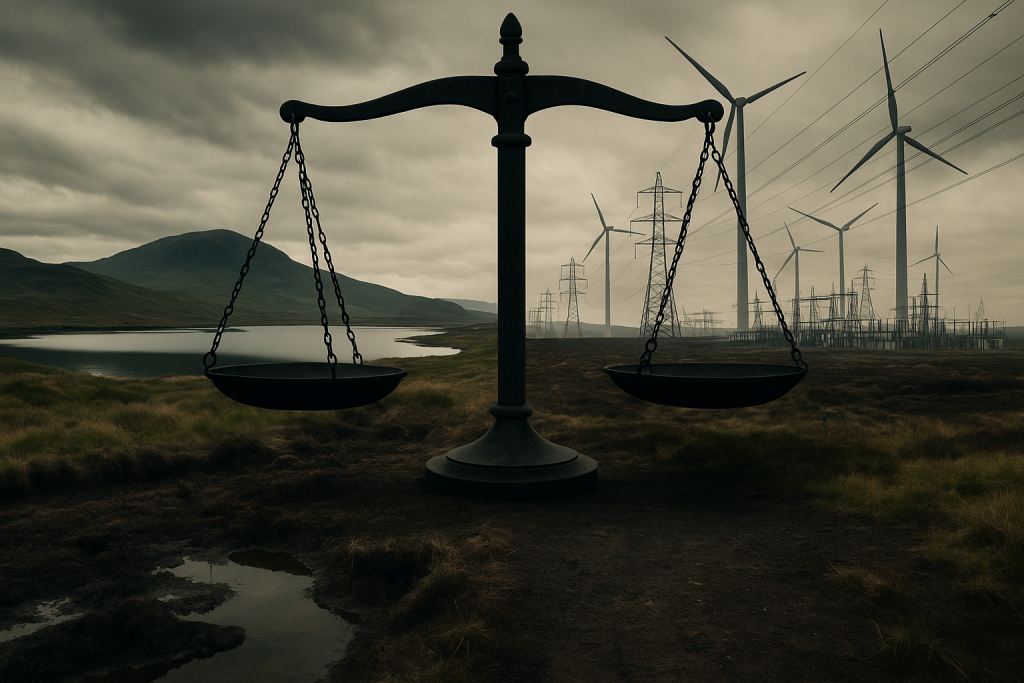
More and more evidence now points to the same unavoidable conclusion. A moratorium is the only credible way to rebalance energy planning in Scotland. Trust has been eroded by opaque decision making, conflicts of interest, and the systematic sidelining of communities.
The Need for a Transparent National Energy Plan and Proper Scrutiny
A coherent, transparent national energy plan must be produced as a matter of urgency. It must demonstrate clearly how developments align with actual energy need, grid capacity, environmental protection, cumulative impact, and democratic consent.
Until proper governance, transparency, and accountability can be demonstrated in practice rather than rhetoric, all major energy developments and planning applications should be halted.
Only by pausing the current pipeline can meaningful scrutiny take place, allowing Scotland to reset an energy system that has been allowed to operate without effective oversight for far too long.

6 Replies to “Scotland’s Energy Scandal: Gillian Martin Quietly Removed Ahead of the Election”
Megan Ross
Excellent analysis…..
Angus Jack
Outstanding work and investigations on the machinations of this SNP government and I say that as an SNP member., thank you all
Carol Roulston
Shifting focus from Gillian Martin to Ivan McKee does not solve the problem of governance, transparency or accountability Unless a moratorium on major electricity projects is called pre election then myself and many others will not be supporting SNP in the forthcoming election.
Karen Cantell
Surely this should be brought to tbe attention of everyone using large headline letters. This is a, disgrace, the whole of SNP government should be shown in their true colours.
Steve Gibb
Shocking but unsurprising behaviour from this administration.
Karin Coltart
Will this apparent transfer of responsibility mean that Gillian Martin will have an excuse not to attend and be questioned at the Petitions Committee on Wednesday 14 January 2026?