
When Participation Is Labelled a Problem

Why Claims of “Spam” Misrepresent Public Objections and Misunderstand Planning Law
In recent months, a narrative has begun to circulate within sections of the planning and development industry suggesting that digitally assisted public objections are “spamming” the planning system. That ObjectNow have been cited as examples of a supposed misuse of technology that, it is claimed, overwhelms decision-makers and undermines consultation.
This framing is misleading. It misrepresents how ObjectNow operates, misunderstands the role of technology within modern planning, and, most importantly, misconstrues the legal duties that govern public participation in planning decisions across Scotland, England, Wales, and Northern Ireland.
At its core, the accusation of “spam” is not a legal argument. It is a reaction to a shift in who is able to participate and how effectively they can do so. It also reveals a growing discomfort within parts of the planning and development sector with the fact that more people are now able to engage meaningfully with proposals that were previously inaccessible to them.
At issue is not technology. It is participation.
Public objection is a legal right, not a system flaw
Across Scotland, England, Wales and Northern Ireland, planning decisions are governed by statutory frameworks that impose a duty on decision-makers to consider representations that raise material planning considerations. That duty arises under primary legislation, secondary regulations governing Environmental Impact Assessment, and long-established principles of public law.
Consultation is not a discretionary courtesy. Where it is required, it must be carried out lawfully, fairly, and in a manner that allows the public a genuine opportunity to understand proposals and respond to them. Decision-makers are required to take those responses into account. There is no provision in planning law that allows objections to be dismissed because they are numerous, well structured, or inconvenient.
The term “spam” has no standing in this framework. It does not appear in statute, planning guidance, consultation regulations, or case law. It is a label imported from digital marketing and content moderation, where it describes unsolicited or automated communications. That concept has no relevance to lawful representations submitted by real people as part of a statutory process via ObjectNow.
Planning authorities may disregard representations that are abusive, irrelevant, or fail to raise material considerations. They may not lawfully invent new categories of exclusion based on subjective discomfort with volume or clarity.

What ObjectNow actually enables
ObjectNow exists because the planning system has become increasingly complex.
Large-scale development proposals, particularly energy and infrastructure projects, now routinely involve application documents running to many thousands of pages. Environmental Impact Assessments are highly technical, densely cross-referenced, and often inaccessible to non-specialists within the timeframes allowed for consultation.
For years, this complexity functioned as an informal barrier. Communities were invited to participate in theory, but shut out in practice.
ObjectNow addresses that imbalance. It does so by supporting campaigners and members of the public to engage with application material, identify issues grounded in evidence, and articulate those issues in a form that meets the requirements of planning law.
Every campaign begins with a foundation objection document written by people, assisted by AI. These documents are produced through human research, drawing directly on application submissions, environmental assessments, consultation responses, and relevant planning policy and legislation. Local knowledge informs how impacts are understood and framed.
Human judgement determines what is relevant and what is not.
These foundation documents are not produced casually. They are drafted, reviewed, proofread, and revised multiple times. Claims are checked against source material. Inaccuracies are removed. Ambiguity is resolved or excluded.
This process exists precisely to ensure that objections are factual, accurate, and defensible.
The role of AI is analytical, not autonomous
Artificial intelligence is used within this process, but only as an assistive tool. Its role is to help examine large volumes of documentation, organise information, and highlight potential inconsistencies or omissions within the applicant’s own material. It supports analysis. It does not replace it.
AI is not permitted to decide that something constitutes a regulatory breach or a planning failure. Those judgements are made by humans. Any issues surfaced through analytical assistance are reviewed, assessed, and verified before they are relied upon.
AI is never allowed to invent impacts, estimate harm, speculate about outcomes, or generate objections independently. It operates within strict constraints and only in support of human-authored and human-verified material.
Human expertise is the foundation, not an afterthought.
Objections generated are not automated submissions
Once a foundation objection document has been prepared and verified, ObjectNow enables individuals to submit representations that are grounded entirely in that evidence. The substance of those objections is not fabricated, inferred, or generated in isolation. It is derived solely from the verified foundation material and remains consistent across all submissions.
Variation arises only in how that evidence is expressed. Different versions may present issues in a different order, place emphasis on different impacts, or adopt a different narrative progression. This reflects the reality that individuals articulate concerns in different ways. It is not an attempt to multiply arguments, inflate objection numbers, or introduce artificial variation.
At no point is factual content diluted or manipulated. Every objection retains the full set of material planning considerations identified in the foundation document. No relevant issue is removed, and no new claim is introduced. This preserves evidential integrity and ensures that each submission meets the legal standard required of a planning representation.
The regenerate function and full editing capability are therefore essential features of the platform, not optional enhancements. Regeneration reinforces that each objection is a distinct engagement with the material rather than a static template. Editing tools ensure that the individual retains full control over the final submission, including the ability to tailor language, adjust emphasis, and include a personal impact statement explaining how the proposal affects them directly.
This human involvement is central to the process. It ensures that each objection represents a genuine personal representation, authored, reviewed, and submitted by a real person, not an automated system.
Claims that this process constitutes “spamming” the planning system are therefore factually incorrect. They misrepresent how ObjectNow operates and ignore the safeguards built into the platform. More seriously, such claims risk defaming ObjectNow by attributing to it conduct that is neither accurate nor lawful, and by undermining the legitimacy of tens of thousands of individuals who have engaged with the planning process in good faith.
Planning law does not require objections to be stylistically unique, informally drafted, or imperfectly expressed. It requires that representations be made by real people and that they raise material planning considerations. Objections submitted via ObjectNow meet those requirements fully and lawfully.
Any assertion to the contrary is not supported by fact, law, or practice.
The accusation reveals the real tension
The discomfort now being expressed is not about automation. It is about scale. More people are participating, and they are doing so in a way that is coherent, informed, and grounded in evidence.
That change exposes a long-standing imbalance. Developers are permitted to submit vast, technically complex applications produced using sophisticated digital tools. The public, until recently, had no equivalent means of understanding or responding to them.
ObjectNow alters that equation. It enables scrutiny where scrutiny was previously impractical.
Labelling this as “spam” does not describe a technical problem. It reframes democratic participation as an inconvenience.
Suppression by method is unlawful in principle
Once it is accepted that objections submitted via ObjectNow are made by real people and raise material planning considerations, the legal position becomes straightforward. Decision-makers are not permitted to discriminate between representations based on the method by which they were prepared.
Across the United Kingdom, public bodies exercising planning functions are bound by principles of administrative law. Decisions must be taken lawfully, rationally, and fairly. Authorities must not fetter their discretion, apply undisclosed criteria, or introduce informal filters that are not grounded in statute or policy.
Treating objections differently because assistive technology was used in their preparation would amount to precisely that. It would introduce a criterion that does not exist in law and apply it selectively to exclude or downweight lawful representations. Any decision reached on that basis would be vulnerable to challenge.
This is not a theoretical concern. Courts have repeatedly held that where consultation is required, it must be carried out properly. Representations must be conscientiously taken into account. A process that appears to accept objections in form but neutralises them in substance is unlikely to meet that standard.
Environmental decision-making strengthens the obligation
Where developments engage Environmental Impact Assessment regimes, the duty to facilitate effective public participation is heightened. EIA regulations across Scotland, England, Wales and Northern Ireland embed requirements derived from retained EU law that emphasise access to information and meaningful engagement.
Meaningful engagement presupposes comprehension. It cannot exist where documentation is so extensive or technical that ordinary members of the public are effectively excluded. In that context, tools that assist analysis and articulation do not undermine participation. They enable it.
Attempting to restrict such tools would move the system in the opposite direction, reinforcing exclusion at precisely the point where environmental law seeks to prevent it.

Organisation is lawful, discounting is not
It is entirely legitimate for authorities to organise consultation responses. Grouping similar themes, summarising points, and managing large volumes of correspondence are all practical necessities.
What is not legitimate is to treat multiple objections as a single representation simply because they raise similar concerns, or to dismiss their cumulative significance. Volume is not determinative, but it is not irrelevant. It can evidence the scale of concern, the extent of perceived impact, and the social weight of an issue.
The introduction of informal labels such as “spam” risks collapsing these distinctions. It invites an approach where objections are managed away rather than assessed. That is not administration. It is distortion.
If any consultation platform or authority were to configure systems in a way that automatically deprioritised objections based on drafting method, rather than content, that configuration would itself form part of the decision-making process.
As such, it would be open to scrutiny and legal challenge.
The imbalance in scrutiny cannot be ignored
Criticism of the use of AI in public objections is increasingly difficult to reconcile with the realities of how planning applications are now produced. Developers routinely rely on automated modelling, templated reporting frameworks, and software-assisted analysis to generate applications of extraordinary scale and complexity. In many cases, those now condemning AI-assisted objections actively promote or provide AI tools to applicants and planning authorities themselves.
That inconsistency is not incidental. It lies at the heart of the problem.
The widespread use of such tools has contributed to an inflation of application documentation to a level that places significant strain on members of the public, community councils, and even planning departments. Consultation material is routinely expanded far beyond what an ordinary person could reasonably digest within statutory timescales.
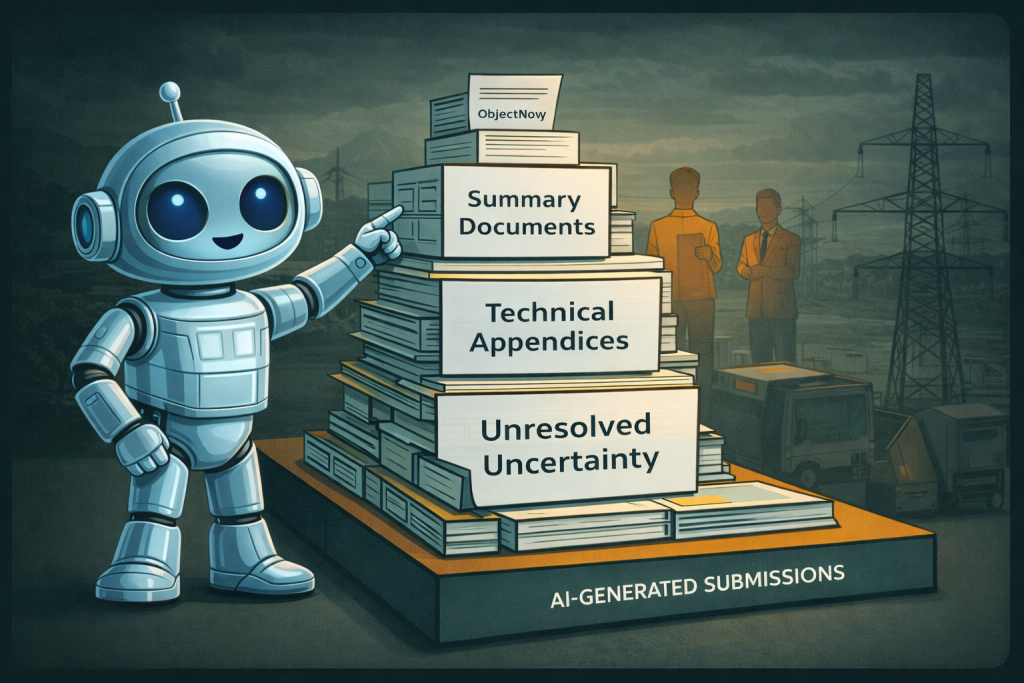
Errors, omissions, and internal contradictions within these documents are not subtle. They are often conspicuous, particularly where summary claims are not supported by the underlying technical material, or where uncertainty is deferred rather than properly addressed.
In that context, the use of assistive technology to examine applications, identify weaknesses, and highlight inconsistencies is not an abuse of the planning process. It is the planning process operating as intended. Public participation exists precisely to test the claims made by applicants, to challenge unsupported conclusions, and to ensure that decision-makers are not relying on assertions that cannot be substantiated.
By contrast, ObjectNow’s use of AI is deliberately constrained. It is focused on factual analysis, regulatory compliance, and evidential accuracy. It does not inflate documentation, speculate about impacts, or obscure uncertainty. It exists to help people navigate and scrutinise an already burdensome system, not to add to that burden.
To condemn assistive tools at the point where scrutiny occurs, while embracing them at the point where applications are produced, is not a principled position. It is an objection to scrutiny itself.
The real source of pressure on the system
Planning authorities and community councils across the UK are under demonstrable strain. Determination periods are routinely extended. Consultation responses increasingly note that application material cannot be reasonably assessed within statutory timescales.
This pressure does not arise because more people are objecting. It arises because application complexity has increased without corresponding reform or resourcing. The burden of that escalation has been displaced onto public bodies and communities.
Suppressing objections does not address this problem. It merely conceals its symptoms. If the system is to remain credible, it must confront the causes of overload, not penalise participation.
Silence speaks as loudly as criticism
Where allegations have been made that ObjectNow are undermining planning through automation or abuse, the absence of engagement with us is telling. No attempt has been made to understand our methodology, verify our safeguards, or test the accuracy of the claims being advanced by those stating we are “spamming” the system.
Responsible analysis requires inquiry. Publishing conclusions without seeking comment from the subject of criticism is not rigorous. It reflects a predisposition towards a narrative rather than an assessment grounded in evidence.
In a system that depends on trust, that omission matters.
Rights are engaged, whether acknowledged or not
At the point where participation is deliberately restricted, devalued, or suppressed, the issue ceases to be procedural and becomes one of rights.
Public participation in planning is not merely an administrative function. It engages fundamental principles of access to justice, equality of arms, and democratic accountability. These principles are reflected across domestic planning legislation, environmental regulations, and retained international obligations that continue to shape decision-making standards within the United Kingdom.
Where environmental effects are concerned, the right of the public to participate meaningfully is not optional. It is embedded in the legal architecture that governs how decisions are made. Any attempt to curtail that participation through informal mechanisms, technical gatekeeping, or discriminatory treatment based on drafting method risks breaching those obligations.
The law does not protect only eloquent or professionally drafted voices. It protects participation itself.

Blocking platforms is not a neutral technical choice
If decision-makers, or systems acting on their behalf, were to attempt to block or exclude objections generated with the assistance of platforms such as ObjectNow, that action would not be a neutral technical measure. It would be a substantive intervention in the consultation process.
Such an intervention would raise immediate questions. On what legal basis is the exclusion being applied? Where is that basis found in statute or guidance? How is consistency ensured? How are affected participants informed? How is fairness preserved?
Absent clear and lawful answers to those questions, any resulting decision would be exposed to challenge. Courts do not look favourably on undisclosed criteria, informal filtering, or post hoc rationalisation of exclusionary practices. The duty to act transparently and lawfully is not displaced by administrative convenience.
Technology is not the problem scrutiny reveals
The resistance to ObjectNow does not arise because we automate participation. It arises because we expose weaknesses in the system that have long been tolerated.
When AI-assisted analysis highlights inconsistencies between application summaries and technical appendices, it reveals drafting failures. When it identifies missing assessments or unresolved uncertainties, it exposes procedural shortcomings. When it enables communities to articulate those issues clearly, it brings scrutiny that might otherwise have been absent.
That scrutiny is not abusive. It is the purpose of consultation fulfilled.
If applications contain flaws, omissions, or unsupported claims, they should be challenged. If those challenges are uncomfortable, the discomfort lies with the quality of the application, not with the tools used to examine it.
Participation has expanded, not degraded
What ObjectNow has changed is not the substance of objections, but the breadth of participation. People who were previously excluded by complexity, time constraints, or technical barriers are now able to engage meaningfully.
That expansion does not degrade the planning process. It strengthens it. Decisions taken after hearing only a narrow subset of voices are not more robust. They are more fragile.
Democratic legitimacy is not achieved by managing participation down. It is achieved by ensuring that participation is real.
The risk of getting this wrong
Attempts to delegitimise digitally assisted objections by labelling them as “spam” risk more than reputational damage. They risk normalising unlawful practice. They invite decision-makers to adopt approaches that are not supported by law and that undermine confidence in the fairness of the system.
They also risk silencing precisely those voices the planning framework is designed to protect: communities affected by development who lack the resources to engage on unequal terms.
That is not reform. It is regression.

The unavoidable conclusion
If developers are permitted to use advanced technology to produce planning applications that are complex, opaque, and in some cases demonstrably flawed, then it must be equally permissible for members of the public to use technology to understand, interrogate, and challenge those applications. There is no lawful or principled basis for treating scrutiny as improper while treating production as legitimate.
AI used to assist analysis and scrutiny is not an abuse of the planning system. It is a response to the system as it now exists. It reflects the scale, complexity, and technical nature of modern applications, and it enables the public to engage with material that would otherwise be inaccessible within consultation timeframes.
Every objection submitted via ObjectNow represents a real individual engaging with a statutory process that has, for many years, excluded all but the most resourced participants. These voices are not artificial. They are not automated submissions. They are lawful representations grounded in evidence and material planning considerations. To characterise them as “spam” is factually incorrect and legally unsustainable.
Any attempt to suppress or devalue such participation would not protect the integrity of the planning system. It would undermine its legality, erode public confidence, and place decision-makers at risk of acting unlawfully by failing to consider material representations fairly and without prejudice.
The question is no longer whether technology belongs in public participation. It already does. The question is whether those operating within the planning and development sector will acknowledge that reality honestly, or continue to apply a double standard that permits the use of AI to produce applications while condemning its use to examine them.
ObjectNow will not accept mischaracterisations that seek to delegitimise public participation, particularly where they originate from organisations that actively promote or provide AI-assisted tools to developers and planning authorities. Such positions are internally inconsistent and invite scrutiny in their own right.
We therefore advise that any published material asserting that AI-assisted objections constitute “spam” be reviewed and corrected to reflect the factual and legal reality. Failure to do so risks public scrutiny of the selective and misleading nature of those claims, and of the role such commentary plays in attempting to marginalise lawful public engagement.
Our position is straightforward. The use of AI to inflate, obscure, or overwhelm consultation material is part of the problem the planning system now faces. The use of AI to examine that material, identify errors, and call out regulatory and evidential failures is part of the solution.
Our correspondence channels remain open. We would welcome factual engagement from those who have chosen to comment on ObjectNow without first seeking to understand how it operates. What we will not tolerate are unfounded assertions that misstate the law, misrepresent our platform, or undermine the legal rights of those who use it to make their voices heard.
Regards,
The ObjectNow Team
Please note that we have deliberately refrained from identifying the source that has described our platform as “spam”. This decision is not driven by legal constraint, as we are fully entitled to respond publicly, but by a matter of principle. We consider it appropriate to allow the party concerned the opportunity to contact us and engage in a constructive discussion. Should no such engagement take place, we reserve the right to update the article accordingly and to identify the source.

2 Replies to “When Participation Is Labelled a Problem”
Martyn Ayre
Many thanks. Essential reading for all of us seeing and feeling the inequality of arms and its basic procedural unfairness.
Karen Cantell
One rule for them and another for us.. Well done object now you truly have helped those who are unable to make head or tails of the planning process and want to object.